

A modern web crawler can be blocked even when the target site loads fine in a normal browser. The difference is that the crawler’s browser is controlled by an automation driver, and the site’s detectors look for inconsistencies across many fingerprint fields. The article walks through the two main mitigation layers—driver patches that silence automation flags, and engine‑level spoofing that aligns the underlying hardware and network fingerprints—so developers can choose the right depth for their use case.
Context and practical value
The source explains how Playwright’s automation driver layer and the underlying hardware/network fingerprint layer can conflict, causing detection by tools like CreepJS, BotD, and FingerprintJS. It compares driver patches (patchright) that silence automation flags with engine‑level spoofing (invisible_playwright) that derives all fingerprint fields from a single seed, ensuring coherence. It also discusses the identity problem in large fleets and provides a practical example of integrating invisible_playwright into a Crawlee project.
This article distills the source’s technical discussion into a structured guide for developers, clarifying the two mitigation layers, explaining why driver patches alone are insufficient, and outlining a step‑by‑step approach to build coherent, distinct identities for scalable crawling. It adds practical code snippets, a decision matrix for choosing the right depth, and a FAQ that addresses common implementation questions.
Key takeaways
- Driver patches (e.g., patchright) silence automation flags but do not fix underlying hardware or network inconsistencies.
- Engine‑level spoofing (e.g., invisible_playwright) derives all fingerprint fields from a single seed, ensuring internal coherence.
- A single identity across many crawler instances is a fingerprint in itself; generating many distinct, coherent identities is essential for large fleets.
Why the Same Page Blocks a Script
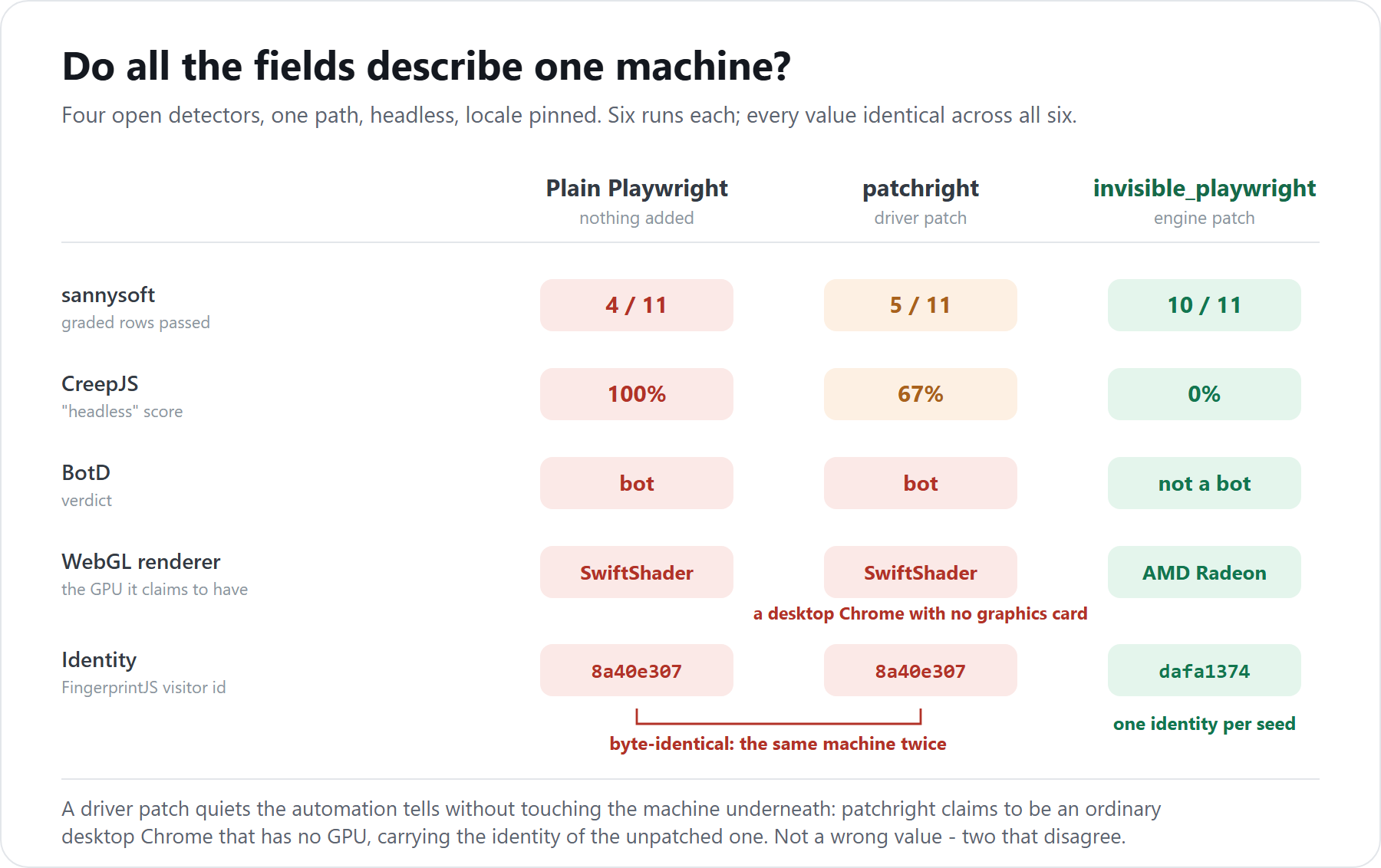
When a page is opened manually, all fingerprint fields describe a single machine: the same GPU string, the same timezone, the same language. A Playwright script, however, presents two independent layers: the automation driver layer (navigator.webdriver, CDP traces) and the hardware/network layer (WebGL strings, timezone, IP). If these two layers do not match, detectors flag the request as a bot. The article shows how detectors like CreepJS, BotD, and FingerprintJS expose this mismatch.
Driver Patches: Fixing the Automation Layer
Patchright replaces the Playwright Chromium driver with a drop‑in that removes the Runtime.enable CDP trace, clears the --enable-automation flag, and sets navigator.webdriver to false. It also removes the window.chrome object. While this makes the driver layer look like a normal desktop browser, the underlying hardware fingerprint (e.g., SwiftShader) remains unchanged, so detectors that weigh the fingerprint still see a bot.
Engine‑Level Spoofing: Aligning All Fields
Invisible_playwright patches the Firefox engine at the C++ level so that every fingerprint field—GPU strings, canvas signatures, audio data, fonts, timezone, language—is derived from a single integer seed. The seed is passed to the browser at launch, and the same seed yields the same visitor ID across runs. This guarantees that the driver layer and the hardware layer describe the same machine, eliminating the contradiction that triggers detection.
The Identity Problem in Large Fleets
Even with a coherent single browser, a fleet that reuses the same seed produces identical fingerprints across thousands of instances. Sites can correlate these identical fingerprints and block the entire fleet. The solution is to generate many distinct seeds, each producing a different coherent identity. Because the seed is stateless, any worker can rebuild the same identity from a queue, enabling scalable, reproducible crawling.
Practical Implementation with Crawlee
The article provides a minimal example of integrating invisible_playwright into a Crawlee project. It shows how to create a custom PlaywrightBrowserPlugin that passes the seed and headless flag, and how to avoid double fingerprinting by omitting the header_generator. It also notes platform differences: Linux requires Xvfb for headless mode, while Windows does not.
Choosing the Right Depth for Your Use Case
For a single or few crawls, a driver patch may be sufficient to bypass simple bot checks. For large‑scale, repeatable crawling, engine‑level spoofing and multiple seeds are necessary to avoid correlation attacks. The article advises measuring detector responses for each approach and selecting the shallowest layer that satisfies the job’s requirements.
Practical next steps
- 1. Install the driver patch (e.g., patchright) and verify that navigator.webdriver is false and no CDP traces appear.
- 2. Add invisible_playwright to your project, passing a unique integer seed for each crawler instance to generate distinct fingerprints.
- 3. Run detector tools (CreepJS, BotD, FingerprintJS) against your patched browser to confirm all fields are coherent and no contradictions remain.
Limits and verification
- The analysis is based on a single benchmark run; real‑world sites may use additional or newer detection techniques that were not covered.
FAQ
Does patchright remove all automation traces?
Patchright removes the most common automation traces such as navigator.webdriver, window.chrome, and CDP Runtime.enable calls, but it does not alter the underlying hardware fingerprint, which can still be detected by more advanced tools.
Can I use invisible_playwright with Chromium?
Invisible_playwright is built for Firefox. For Chromium you would need a similar engine‑level spoofing tool; otherwise, you must rely on driver patches alone.
How many distinct seeds are safe for a fleet?
There is no hard limit; each unique integer seed produces a distinct fingerprint. However, you should monitor for correlation attacks and rotate seeds periodically to stay ahead of evolving detection.